Cat Food Reviews Travel: Cat Food Reviews for Travelers: What Actually Survives the Car Ride
You already know the problem. You pack the food. You drive three hours. You open the can at a rest stop. Your cat sniffs it, looks at you like you’ve committed a crime, and walks away. Now you’re stuck with an open can of salmon pâté in a hot car and a hungry animal who won’t eat it.
Most cat food reviews test in kitchens. That’s useless for people who need food that holds up in a cooler, a backpack, or a hotel mini-fridge. This guide looks at cat food the way a traveler actually uses it: opened in weird places, served at odd hours, and expected to work the first time.
The Real Problem: Temperature Abuse and Texture Collapse
Wet food fails on the road in predictable ways. The pâté separates. The gravy turns watery. The food gets warm, then cold, then warm again. Cats notice. A cat that eats Fancy Feast Classic Pâté at home might refuse the same food at hour five of a drive because the texture has shifted.
Dry food has its own failure mode. It absorbs humidity from the air. In a car with the AC cycling on and off, that means kibble goes stale faster than the “best by” date suggests. You’re not fighting spoilage as much as you’re fighting staleness. Cats reject stale kibble for reasons humans can’t smell.
This is not legal advice — consult a licensed veterinarian before changing your cat’s diet. But the mechanical reality is simple: food that changes texture during transport is food your cat may refuse. Plan for that.
What Actually Holds Up
Pâté-style wet foods generally survive temperature swings better than flaked or shredded varieties. Flakes break apart when jostled. Shreds turn to mush. Pâté is already a uniform paste, so it has less to lose. Weruva’s pâté line and Tiki Cat’s After Dark pâtés both hold their consistency better than their shredded siblings after a day in a cooler.
Single-Serve Is Not a Luxury
On the road, single-serve portions solve the open-can problem. You open it, you serve it, you throw away the container. No half-empty can in a Ziploc bag leaking into your cooler. Fancy Feast Classic Pâté comes in 3-ounce cans that work as single servings for most cats. They cost about $0.75 per can at most grocery stores. That’s cheaper than dealing with a ruined cooler.
Dry Food: The 48-Hour Rule Nobody Tells You
Dry food in a car has a shelf life measured in hours, not weeks. Once you open a bag, air and humidity get in. In a moving car, the bag gets squeezed, shaken, and exposed to sunlight through windows. The food inside degrades.
Here’s the rule I follow: portion dry food into sealed bags before you leave. Each bag holds one meal. Squeeze the air out. Don’t open the main bag until you need the next portion. This keeps the bulk of the food sealed and fresh while the travel portions absorb the abuse.
| Brand | Type | Travel Durability | Price per Meal | Notes |
|---|---|---|---|---|
| Hill’s Science Diet Adult Indoor | Dry kibble | Good if portioned | $0.35 | Uniform kibble size, less dust |
| Royal Canin Feline Health Nutrition | Dry kibble | Good if portioned | $0.50 | Dense kibble, resists crushing |
| Purina Pro Plan Sensitive Skin & Stomach | Dry kibble | Fair | $0.40 | Coating can get sticky in heat |
| Fancy Feast Classic Pâté | Wet, single-serve | Excellent | $0.75 | Stable texture, easy cleanup |
| Weruva Pâté (various flavors) | Wet, single-serve | Excellent | $1.50 | Higher protein, holds shape |
| Tiki Cat After Dark Pâté | Wet, single-serve | Very good | $1.75 | Rich, but some cats find it too dense |
Prices are approximate per meal for an average 10-pound cat. Your cat’s needs vary. Consult a veterinarian for portion guidance. This table is not medical advice.
Three Mistakes That Ruin Road-Trip Feeding
Most travel feeding problems come from three avoidable mistakes.
Mistake one: switching food the day you leave. Cats need a week minimum to adjust to new food. If you switch to a “travel-friendly” food on departure day, you’re combining dietary stress with travel stress. The result is usually diarrhea in a car. That’s a bad combination. Make any food change at home, at least seven days before departure.
Mistake two: relying on a cooler you can’t monitor. A cooler in a trunk gets hot. A cooler in a backseat gets sun. Wet food needs to stay below 40°F once opened. If you can’t check the temperature, don’t pack opened wet food. Stick to dry food or single-serve cans you open right before serving.
Mistake three: forgetting that cats drink less when stressed. Dry food plus low water intake equals constipation. Carry a water bottle dedicated to your cat. Offer water at every stop. Some cats won’t drink from a bowl in a moving car. A PetSafe Drinkwell travel bowl or a simple collapsible silicone bowl works. The point is access, not gadgetry.
A Short Verdict on Wet vs. Dry for Travel
For trips under 48 hours, single-serve wet food wins. Less staleness risk, easier portion control, no open-can problem.
For trips over 48 hours, dry food portioned into sealed bags is more practical. You can’t keep wet food cold indefinitely without a powered cooler. Dry food doesn’t spoil as quickly. The tradeoff is hydration, which you solve with deliberate water offers.
There is no perfect answer. There is only the right answer for your specific trip length and your cat’s specific stubbornness.
What to Look For on the Label (Travel Edition)
When you’re reading cat food labels for travel, you’re looking for three things that don’t matter at home.
1. Moisture Content
Wet food with higher moisture content helps hydration on the road. Look for foods that list water or broth as the first or second ingredient. Weruva is known for high-moisture formulas. That’s a feature, not a flaw, when your cat won’t drink from a travel bowl.
2. Calorie Density
Travel burns energy. Stress burns energy. A cat that won’t eat much on the road needs more calories per mouthful. Check the kcal per can or cup. Tiki Cat After Dark runs around 80-90 kcal per 3-ounce can. That’s higher than many grocery-store brands. For a cat that eats half portions while stressed, density matters.
3. Ingredient Simplicity
The fewer ingredients, the fewer variables when something goes wrong. If your cat gets an upset stomach on the road, you want to know exactly what they ate. A food with five ingredients is easier to troubleshoot than a food with thirty. This is not about “clean eating.” It’s about diagnostic clarity.
When Not to Buy “Travel” Cat Food
There is no such thing as travel cat food. There is only cat food that happens to survive travel. Companies that market “travel packs” or “on-the-go” cat food are usually selling smaller portions at higher prices. You can achieve the same thing by portioning regular food into small bags or buying single-serve cans.
Don’t buy a special travel food unless your cat has a medical need that requires it. Hill’s Science Diet and Royal Canin both make prescription diets that some cats need. If your cat is on one of those, travel with that food. Don’t switch to a “travel” brand. The prescription food exists because your cat’s health depends on it.
The exception is if your cat is a picky eater who only eats one specific food. Then that food is your travel food, whether it’s convenient or not. Bring more than you think you need. A cat that refuses to eat on a trip is a cat that develops hepatic lipidosis faster than you’d expect. That’s a liver condition caused by not eating. It’s serious. It’s expensive. It’s avoidable by bringing food your cat will actually eat.
This is not legal advice — consult a licensed veterinarian about any health concerns for your cat.
Final Comparison: What I’d Pack for Different Trips
If I’m driving four hours to a family visit and staying two nights, I pack Fancy Feast Classic Pâté in 3-ounce cans. One can per meal. No cooler needed if I serve immediately. The cat eats it. The trash goes in a gas station bin. Done.
If I’m flying, I pack Hill’s Science Diet Adult Indoor portioned into sealed bags. Dry food survives TSA inspection better. I buy wet food at the destination if I need it. Less weight, less hassle.
If I’m camping for a week, I pack Weruva Pâté single-serve cans and a collapsible bowl. The high moisture content helps hydration when water access is unpredictable. I accept the weight penalty because the hydration benefit outweighs it.
For the picky eater who refuses everything, I pack whatever they eat at home. Nothing else matters. Convenience is irrelevant if the cat won’t eat.
| Trip Type | Best Choice | Why |
|---|---|---|
| Short drive (under 6 hours) | Fancy Feast Classic Pâté | Single-serve, stable texture, cheap |
| Long drive (over 6 hours) | Hill’s Science Diet Adult Indoor, portioned | No spoilage, easy to pack |
| Flight | Hill’s Science Diet Adult Indoor, portioned | TSA-friendly, lightweight |
| Camping (multi-day) | Weruva Pâté | High moisture, durable texture |
| Picky eater | Whatever they eat at home | Refusal risk outweighs all other factors |
The food that works is the food your cat eats. Everything else is logistics. Solve the logistics so the food can do its job. That’s the whole game.
Related Post

Pet-Friendly Travel Rewards: When A Card Actually Helps Dog And Cat Owners
Travel cards only belong on this site when they are tied to real pet travel [...]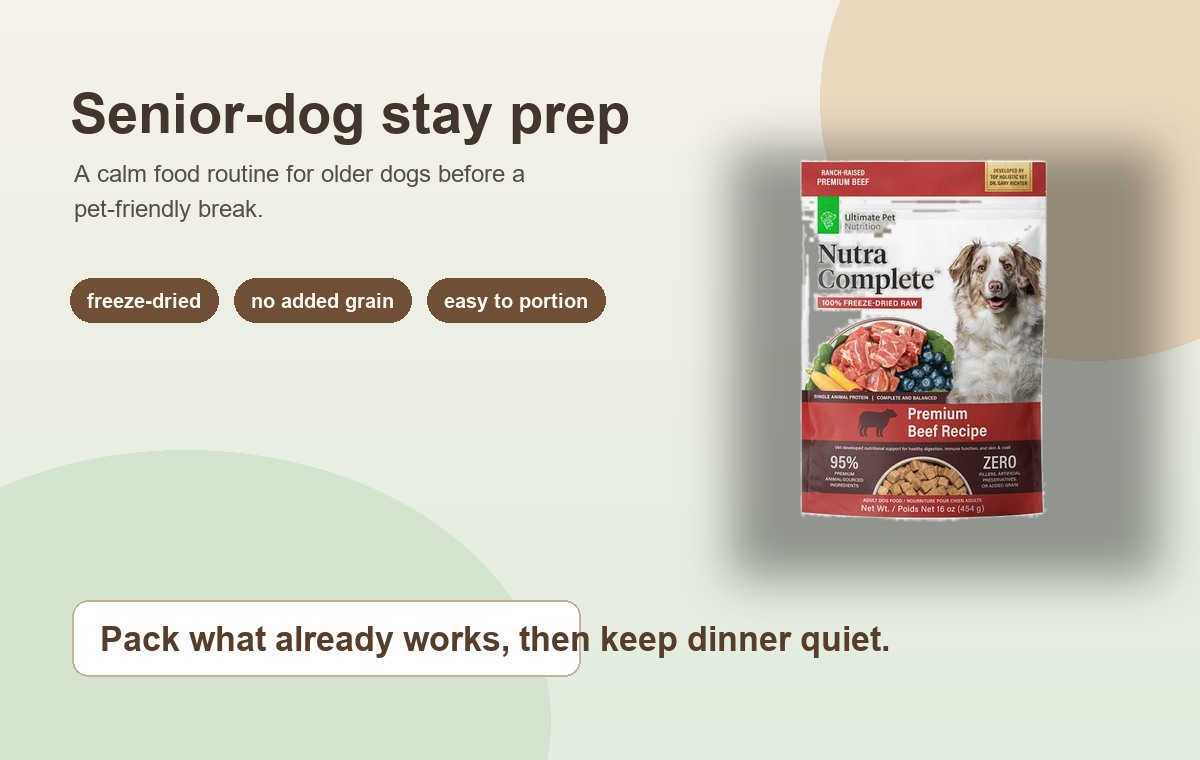
A Senior Dog Meal Routine for Pet-Friendly Trips
Older dogs often enjoy a change of scenery, but their meals usually ask for less [...]