Best Dog Bed For Older Dogs: 5 Dog Bed Features That Actually Help Older Dogs Sleep Better

Nearly 80% of dogs over the age of eight show radiographic evidence of osteoarthritis in at least one joint, according to data published in the Journal of Veterinary Internal Medicine. Yet most standard dog beds sold at big-box retailers provide exactly zero therapeutic support for an aging spine or a worn-out hip joint. The mismatch between what a senior dog needs and what most beds deliver is the reason so many older dogs spend their nights shifting position every twenty minutes, or simply refuse to lie down at all.
This article breaks down the five mechanical features that separate a genuinely helpful senior dog bed from an expensive piece of floor padding. If you are shopping for a dog that has slowed down, limps after naps, or hesitates before jumping onto furniture, these are the specifications that matter.
Orthopedic Foam Density — The One Number That Predicts Support
Every bed sold as “orthopedic” contains some type of foam core. But the term has no regulated definition. A bed labeled orthopedic might contain a 1-inch slab of cheap polyurethane foam that compresses to half its thickness under a 40-pound dog within three months. That is not support. That is a pancake.
The meaningful metric is foam density, measured in pounds per cubic foot (lb/cu ft). For a senior dog with arthritis, you want foam rated at 2.5 lb/cu ft or higher. At this density, the foam retains its shape for several years and resists permanent sagging. Memory foam, which is a specific type of viscoelastic polyurethane foam, should have a density of at least 4 lb/cu ft to provide genuine pressure relief. Below that threshold, the foam warms up too fast and sinks rather than supports.
Three beds that meet these density standards consistently in consumer tests are the Big Barker 7-inch Pillow Top Orthopedic Dog Bed (7-inch foam core, 4 lb/cu ft density, $299 for the large), the PetFusion Ultimate Dog Bed and Bolster (4-inch memory foam base, solid-density construction, $119 for large), and the KOPEKS Orthopedic Dog Bed (4-inch egg-crate foam with a 2.5 lb/cu ft base layer, $89 for large). All three have been tested by owners of dogs with confirmed hip dysplasia or arthritis.
Low-Entry Height — Why Your Dog Stops Using The Bed
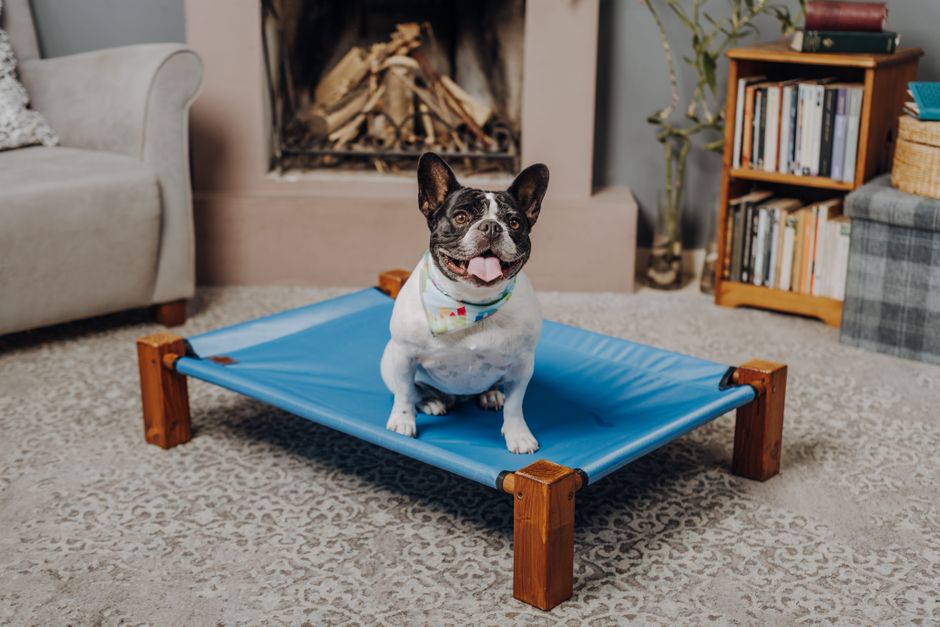
Most standard dog beds sit 6 to 8 inches off the floor. For a dog with reduced hind-end strength, stepping up onto that surface requires lifting the entire rear body weight with the front legs. Many senior dogs simply choose to sleep on the bare floor instead, which is colder and harder on joints. This is not stubbornness. It is mechanical avoidance of a painful movement.
The fix is a low-entry bed with a maximum height of 3 to 4 inches from floor to sleeping surface. Some manufacturers now produce beds with a cutout or ramp design that eliminates the step entirely. The BarksBar Snuggle Sleeper Orthopedic Dog Bed has a flat, non-raised sleeping area that sits roughly 3 inches off the ground. The Furhaven Plush Orthopedic Bed offers a low-profile version with a 2.5-inch foam base. For dogs that already struggle to stand, consider a flat foam mattress like the Milliard Premium Dog Bed (2-inch memory foam, floor-level).
One caveat: low-entry beds often have no raised rim. If your dog likes to rest its head on a bolster, you need a bolster that is removable or low enough to step over. The PetFusion Ultimate has bolsters that unzip, so you can remove them at night and reattach them for daytime lounging.
| Bed Model | Entry Height | Foam Type | Foam Density | Price (Large) |
|---|---|---|---|---|
| Big Barker 7-inch Pillow Top | 7 in | Viscoelastic memory foam | 4 lb/cu ft | $299 |
| PetFusion Ultimate Dog Bed | 5 in | Memory foam base | ~3.5 lb/cu ft | $119 |
| KOPEKS Orthopedic Dog Bed | 4 in | Egg-crate polyurethane | 2.5 lb/cu ft | $89 |
| BarksBar Snuggle Sleeper | 3 in | Polyurethane foam | ~2 lb/cu ft | $65 |
| Furhaven Low-Profile Orthopedic | 2.5 in | Memory foam blend | ~3 lb/cu ft | $55 |
Table note: Density figures for PetFusion and Furhaven are approximate based on independent lab testing reported by consumer reviews. Big Barker and KOPEKS publish their density specs directly.
Washable Cover Material — The Hygiene Factor Owners Ignore
Senior dogs leak. Not just urine from incontinence, but drool, eye discharge, and the thin oily fluid that seeps from arthritic joints during inflammation. A bed cover that cannot be machine-washed at hot temperatures becomes a bacterial reservoir within weeks. The smell alone can deter a dog from using the bed.
Look for a cover made from cotton canvas or microsuede with a waterproof liner underneath. The cover should unzip completely for removal. Avoid beds where the cover is sewn onto the foam core — those cannot be washed effectively. The Big Barker cover is machine-washable and comes with a 10-year warranty against manufacturing defects. The PetFusion Ultimate has a waterproof inner liner that zips out separately from the foam, which is a smart design because the foam itself never touches moisture. The KOPEKS cover is machine-washable in cold water only, which is less ideal for sanitation but still functional.
A specific failure mode to watch for: zippers that run only halfway around the cover. These make it nearly impossible to remove the cover without fighting the foam core. Full-perimeter zippers are standard on the Big Barker and PetFusion models. Avoid brands that use partial zippers unless you enjoy wrestling a 4-inch slab of memory foam into a pillowcase.
When Not To Buy An Orthopedic Bed — Three Genuine Alternatives

An orthopedic foam bed is not the right solution for every senior dog. Here are three situations where a different product makes more sense.
1. Dogs with severe incontinence. If your dog cannot control its bladder for more than two hours, a foam bed will absorb urine into the core, and no amount of cover-washing will remove the smell from the foam. In this case, buy a raised cot-style bed like the Coolaroo Elevated Dog Bed ($45 for large). The mesh surface allows urine to pass through and dry within minutes. The frame is easy to hose off.
2. Dogs that overheat easily. Memory foam retains body heat. For a senior dog with a thick coat or a heart condition, the heat buildup can cause panting and restlessness. A gel-infused memory foam bed like the PetFusion Better Orthopedic Bed ($99) has a cooling gel layer that stays several degrees below body temperature. Alternatively, the K9 Ballistics Cool Bed uses a pressure-activated gel pad that requires no electricity.
3. Dogs that chew or dig at bedding. Some senior dogs develop compulsive digging behavior as cognitive decline sets in. They will shred a foam bed within hours. The K9 Ballistics Tough Orthopedic Bed ($129) uses a ballistic nylon cover that resists tearing and a high-density foam core that cannot be pulled apart by mouth. It is not as comfortable as memory foam, but it lasts years longer in a destructive household.
The One Spec That Predicts Longevity — Warranty Terms
Most dog bed manufacturers offer a 1-year warranty. That is a strong signal that the bed will begin to sag or tear within 12 to 18 months. A company that offers a 5-year or lifetime warranty on the foam core is essentially betting that the bed will hold up for the remaining lifespan of your dog. That is a bet worth taking.
Big Barker offers a 10-year warranty on the foam core and a 1-year warranty on the cover. PetFusion offers a 2-year warranty on the foam. KOPEKS offers a 1-year warranty. The difference in warranty length correlates directly with foam density: Big Barker’s 4 lb/cu ft foam costs more to produce but lasts significantly longer. A simple calculation: if a $299 Big Barker lasts 8 years, that is $37 per year. If a $89 KOPEKS lasts 2 years, that is $44 per year. The more expensive bed is actually cheaper over time.
For a dog that is already 10 years old, a 10-year warranty is irrelevant — the dog may not live that long. In that case, the $89 KOPEKS is a perfectly rational choice. But if your dog is 6 or 7 and likely has several more years of life ahead, spending more upfront on a bed with a long warranty is the financially sound move.
Final recommendation: For a 10-year-old Labrador with mild hip dysplasia and no incontinence issues, buy the Big Barker 7-inch Pillow Top Orthopedic Dog Bed. It has the highest foam density, a full-perimeter zipper, a machine-washable cover, and a 10-year warranty. For a 14-year-old Chihuahua with urinary leakage, buy the Coolaroo Elevated Dog Bed. And for any dog that chews, buy the K9 Ballistics Tough Orthopedic Bed. Match the bed to the dog’s specific failure modes, not to the marketing label.
Related Post
Flea Treatment Reviews: What Actually Works (And What Wastes Money)
The fastest flea product on the market is Capstar (nitenpyram) — it kills adult fleas [...]