Why Is My Cat Throwing Up Brown Liquid? 3 Vet Explained Reasons
You walk into the living room and see a puddle of brown liquid on the rug. Your cat looks at you like nothing happened. Your first thought is panic. Your second thought is: what does brown vomit actually mean?
Brown liquid cat vomit is not normal. It signals one of three things: digested blood from the stomach or upper intestine, regurgitated food from the esophagus, or material from the colon. Each cause points to a different problem — and some are life-threatening.
Here are the three vet-explained reasons your cat is throwing up brown liquid, exactly what each looks like, and what you should do next.
1. Digested Blood (Hematemesis) — The Most Serious Cause
Brown liquid that looks like coffee grounds is almost always digested blood. Fresh blood is bright red. Once it sits in the stomach or passes through the upper intestine, digestive enzymes turn it dark brown. This is called hematemesis.
Veterinarians consider this an emergency. The blood is coming from somewhere in the esophagus, stomach, or duodenum (the first part of the small intestine).
What causes the bleeding?
Several conditions can cause internal bleeding in a cat’s upper GI tract:
- Gastric ulcers — Often caused by stress, certain medications (especially NSAIDs like aspirin or meloxicam), or underlying kidney disease. A 2017 study in the Journal of Feline Medicine and Surgery found that 23% of cats with chronic kidney disease had gastric ulcers at necropsy.
- Toxins — Rat poison (anticoagulant rodenticides) stops blood from clotting. Even a tiny amount can cause internal bleeding that shows up as brown vomit. Symptoms appear 3–7 days after ingestion.
- Foreign bodies — A swallowed object (string, toy, bone) can scrape or perforate the stomach lining. String is especially dangerous because it can saw through the intestinal wall.
- Cancer — Mast cell tumors, lymphoma, or adenocarcinoma in the GI tract can bleed intermittently.
- Liver or pancreatic disease — These organs affect blood clotting factors. When they fail, spontaneous bleeding can occur.
What to do right now
If the vomit looks like coffee grounds, call your vet or an emergency animal hospital immediately. Do not wait to see if it happens again. Take a photo of the vomit on your phone — vets will ask what it looked like. Bring your cat in for an exam, blood work, and possibly imaging (X-rays or ultrasound).
A single episode of brown liquid with coffee-ground texture means you have hours, not days, to get treatment. Cats hide pain well. By the time you see blood, the problem is often advanced.
2. Regurgitated Food From the Esophagus — Often Mistaken for Vomit
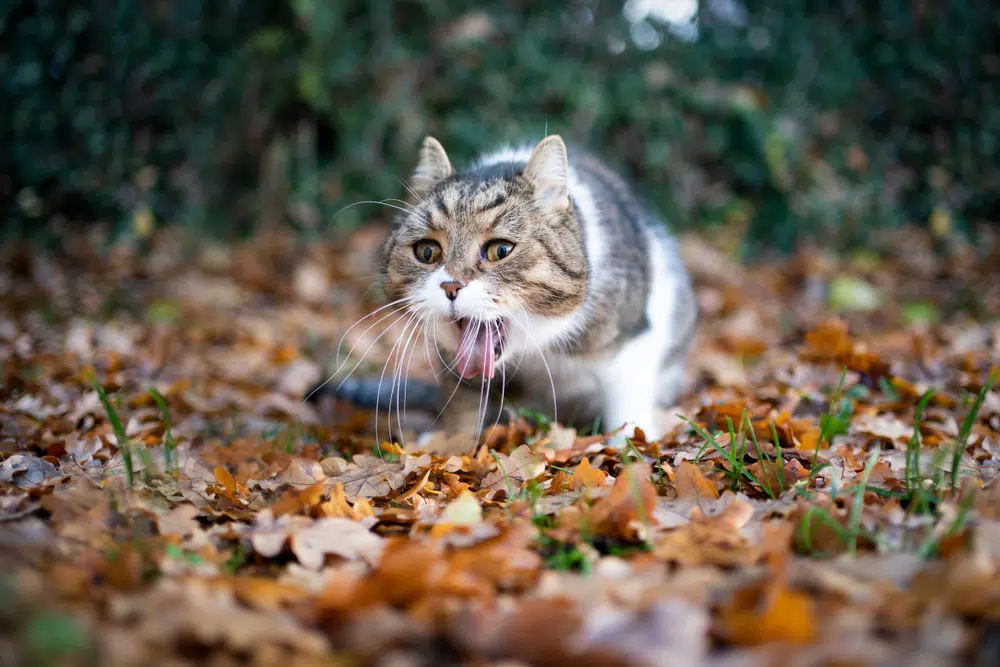
There is a difference between vomiting and regurgitation. Vomiting is active — the cat heaves, contracts its abdominal muscles, and forces stomach contents up. Regurgitation is passive. Food comes back up from the esophagus without effort. The cat simply opens its mouth and brown liquid or mushy food falls out.
Regurgitated material often looks brown because it is partially digested or mixed with saliva and esophageal mucus. It may contain whole kibble pieces if the food never reached the stomach.
Common causes of regurgitation
- Eating too fast — Some cats inhale their food and the esophagus cannot move the bolus down fast enough. The food backs up and comes out brown and slimy.
- Esophageal stricture — A narrowing of the esophagus, often from chronic acid reflux or a previous foreign body. Food gets stuck at the narrowed point.
- Megaeesophagus — The esophagus loses muscle tone and becomes a floppy tube. Food sits there until it comes back up. This is rare in cats compared to dogs, but it happens.
- Hairballs mixed with food — A hairball can lodge in the esophagus, trapping food behind it. The cat regurgitates the whole mess — brown liquid, food, and hair.
How to tell the difference
Watch your cat for 30 seconds after it vomits or regurgitates. If the cat is acting normal, walking away, and looking for food, it was probably regurgitation. If the cat is drooling, hiding, or acting nauseated (licking lips, swallowing repeatedly), it was vomiting.
For regurgitation, try these fixes before seeing a vet:
- Feed smaller meals more often (4–6 per day instead of 2)
- Use a slow-feeder bowl or a puzzle feeder to slow eating speed
- Elevate the food bowl 4–6 inches off the ground
- Keep the cat upright for 10 minutes after eating
If regurgitation happens more than twice in a week, schedule a vet visit. An esophageal stricture or megaesophagus needs veterinary diagnosis and treatment.
3. Colonic Material (Poop) — Yes, Cats Can Vomit Feces
This sounds horrifying, but it is a real phenomenon. When a cat has a complete intestinal blockage — usually in the lower small intestine or colon — the contents have nowhere to go. The intestines keep contracting, and eventually the material backs up all the way to the stomach. The cat vomits brown liquid that smells like feces.
This is called feculent vomiting. It is a surgical emergency.
What causes a complete blockage?
- Foreign bodies — String, ribbon, tinsel, fabric, or small toys. Linear foreign bodies (string) are especially dangerous because they anchor somewhere in the GI tract and the intestines bunch up around them like an accordion.
- Intussusception — One section of the intestine telescopes into another, creating a physical block. This is more common in kittens under 1 year old.
- Tumors — Intestinal lymphoma or adenocarcinoma can grow large enough to obstruct the lumen.
- Constipation or obstipation — Severe, chronic constipation can pack the colon so full that nothing passes. Cats with megacolon or chronic kidney disease are at higher risk.
The signs you cannot miss
A cat with a complete blockage will show these signs within 24–48 hours:
- Repeated vomiting that starts clear or yellow and turns brown over time
- No bowel movements for 24+ hours
- Lethargy — the cat stops grooming, hides under furniture
- Painful abdomen — the cat may cry when you pick it up or touch its belly
- Loss of appetite — refuses food and water
If you see brown vomit and your cat has not pooped in a day, go to the emergency vet immediately. Surgery is the only option for a complete blockage. Waiting costs time and money — and can cost your cat its life.
When Brown Vomit Is NOT an Emergency
There are two situations where brown liquid is not a medical emergency. Both are rare, but they happen.
Situation 1: Your cat ate something brown. If your cat got into a bag of chocolate pudding, brown gravy, or dark-colored wet food, the vomit will be brown. Check the ingredients. If the cat ate chocolate, that is toxic — call pet poison control (ASPCA Poison Control: 888-426-4435, $95 fee). If it was nontoxic (gravy, pudding), the vomit is just food. No vet visit needed unless the cat vomits repeatedly.
Situation 2: A single hairball with food residue. Sometimes a hairball sits in the stomach long enough that it gets coated in partially digested food. When the cat vomits it up, the liquid around the hairball looks brown. If the cat passes the hairball, acts normal, and does not vomit again, you can monitor at home. Offer a hairball-control diet (like Hill’s Science Diet Hairball Control, $22 for a 7-lb bag) and brush your cat daily to reduce fur ingestion.
What Your Vet Will Do — The Diagnostic Workup
When you bring your cat in for brown vomiting, the vet will follow a specific sequence to find the cause. Knowing this helps you prepare and ask the right questions.
Step 1: History and physical exam
The vet will ask about diet, access to toxins, recent medication, and whether the cat goes outside. They will palpate the abdomen to feel for masses, pain, or thickened intestines. A cat with a foreign body may have a “rope-like” feel in the abdomen.
Step 2: Blood work and fecal exam
A CBC (complete blood count) checks for anemia from blood loss and infection. A chemistry panel checks kidney and liver function. A fecal floatation checks for parasites like Toxocara cati or Giardia, which can cause chronic vomiting. Cost: $150–$300 at most clinics.
Step 3: Imaging
- X-rays — Can show foreign bodies, obstructions, or tumors. A barium series (swallowing a contrast liquid) helps identify partial blockages. Cost: $200–$500.
- Ultrasound — Better for seeing soft tissue: thickened intestinal walls, tumors, intussusception. Cost: $300–$600.
Step 4: Endoscopy or surgery
If the vet suspects a foreign body or needs a biopsy, endoscopy (a camera down the throat) can retrieve some objects. Surgery (exploratory laparotomy) is needed for complete blockages or linear foreign bodies. Cost: $1,500–$5,000 depending on complexity and location.
What to Do While You Wait for the Vet
You cannot treat brown vomiting at home. But you can take these steps to help your cat and your vet:
- Take a photo of the vomit. Vets need to see the color, texture, and consistency. A photo is better than your description.
- Collect a sample. If possible, scoop the vomit into a clean ziplock bag or a plastic container. The vet may want to test it for blood.
- Remove all food and water. Do not let your cat eat or drink until the vet says it is safe. If there is a blockage or ulcer, food will make things worse.
- Check for other symptoms. Is your cat lethargic? Hiding? Refusing to move? Has it pooped in the last 24 hours? Write this down for the vet.
- Secure any toxins. If you think your cat ate something poisonous (lilies, ibuprofen, rat poison), bring the packaging or plant to the vet.
Brown Cat Vomit: Quick Reference Guide
| Appearance | Most Likely Cause | Urgency | What to Do |
|---|---|---|---|
| Coffee-ground texture, dark brown | Digested blood (hematemesis) | Emergency — see vet today | Go to ER vet immediately |
| Mushy brown with whole kibble pieces, no heaving | Regurgitation from esophagus | Low — monitor for 24 hours | Try slow feeding; see vet if repeated |
| Brown liquid with fecal odor, no stool in 24+ hours | Complete intestinal blockage | Emergency — surgery needed | Go to ER vet immediately |
| Brown liquid after eating chocolate or gravy | Ingested food (nontoxic or toxic) | Depends on substance | Call poison control if chocolate; otherwise monitor |
| Single hairball with brown liquid | Hairball with food residue | Low — if cat acts normal | Monitor; brush daily; consider hairball diet |
The bottom line: Brown vomit that looks like coffee grounds or smells like feces is a red flag. Regurgitation of recently eaten food is less urgent but still needs attention if it happens often. When in doubt, take a photo, call your vet, and bring your cat in. A $50 exam fee is cheaper than a $3,000 surgery — or losing your cat.
Related Post

Keep Your Dog or Cat at a Healthy Weight
Skip the specialty food aisle for now. The single most important thing you can do [...]
Why Do Cats Gag? 10 Vet-Verified Reasons & When to Worry
Our cats are always nosing about, getting into all sorts of things. They see something [...]